Cotton vs. Polyester Bias Tape: Technical Guide for Industrial Garment Manufacturing
Cotton or polyester bias tape? We analyse technical differences, properties and industrial performance. Choose the best tape for your garments with Byetsa.
 By Francesco ZagnoniPublished on Updated on 8 min read
Quick answer
Cotton bias binding is the right choice when comfort against the skin, absorbency and a matt finish come first; polyester, when mechanical strength, colour fastness and quick drying matter. The cotton-polyester blend balances both.
Key points
- Cotton is hydrophilic, breathable, hypoallergenic and does not build up static; it is recommended for babywear, lingerie and bed linen.
- Polyester is tough and hydrophobic, recovers its shape and holds its colour against bleach and sunlight.
- Ironing: cotton withstands up to 200 °C; polyester can turn shiny or melt above 150 °C.
- Cotton shrinks by 3-5% if not sanforised; match the dimensional stability of the bias binding to that of the fabric.
- The cotton-polyester blend is the middle option for uniforms and hospitality, suitable for industrial washing.
Raw Material Basics: Cellulose vs. Synthetic Polymers
In garment engineering, the choice between a natural and a synthetic fibre is never a matter of chance. It is a technical decision that defines the functional DNA of the garment. When speaking of bias tape, the component that finishes, closes, and edges, this choice becomes critical.
The behaviour of the bias tape during the sewing process and, later, throughout the product’s lifespan, depends directly on its molecular composition. Working with a living cellulosic fibre is not the same as working with an inert thermoplastic polymer.
Understanding the structural differences between cotton and polyester allows the production manager and designer to anticipate common issues. We’re talking about defects such as differential shrinkage, colour shifting, or breakage due to mechanical fatigue.
In this technical analysis, we will break down the properties of both materials. Our goal is to offer a clear guide for specifying supplies in the modern textile industry, where quality and efficiency must go hand in hand.
Cotton Bias Tape: Hydrophilic Structure, Breathability, and Hypoallergenic Behaviour
Cotton is the quintessential natural fibre. Its cellulose-based molecular structure gives it a fundamental property: hydrophilicity. It can absorb up to 8% of its weight in water without feeling wet to the touch.
This moisture management ability makes it the gold standard for garments in direct contact with the skin. In edging applications, our cotton bias tape offers a soft and "dry" feel that prevents irritation from friction.
On a microscopic level, cotton fibre is a flat, twisted ribbon. This creates an irregular surface that diffuses light (matt appearance) and traps air, improving thermal insulation.
For children's clothing, lingerie, and bedding, cotton is irreplaceable. Its hypoallergenic character ensures that the garment's finish, often the part pressing most against the skin (on collars and armholes), is biologically safe.
Moreover, cotton has excellent electrostatic stability. It does not accumulate static electricity, making the cutting and sewing process easier in dry environments, preventing the bias from sticking to cutting tables or machine guides.
Polyester Bias Tape: Tenacity, Hydrophobicity, and Mechanical Tensile Strength
At the other end of the spectrum is polyester, a synthetic fibre derived from petroleum. Its main technical asset is tenacity, being an extremely strong and abrasion-resistant fibre.
Unlike cotton, polyester is hydrophobic; it repels water and dries quickly. This property makes it ideal for sportswear, workwear, and outdoor garments, where sweat management and weather resistance are top priorities.
Its long-chain polymer structure provides exceptional resilience. Polyester bias tape instantly recovers its original shape after being stretched or wrinkled.
However, for those seeking a balance between the strength of synthetic fibres and the softness of natural ones, there is a third way. The poly-cotton bias tape (blend) combines the mechanical durability of the polymer with the pleasant feel of cellulose.
This hybrid option is very popular in the uniform and hospitality sector. It allows garments to withstand aggressive industrial laundering without losing the traditional cotton look.
Natural Elastic Response of Bias Cuts by Fibre Type
The "miracle" of the bias cut lies in its ability to turn flat fabric into an elastic tape. However, the extent of this elasticity varies depending on the base fibre.
Cotton, with its discontinuous fibre structure, offers a bias tape with soft and mouldable elasticity. It can be easily "tamed" with an iron, allowing pronounced curves to be shaped with steam and moist heat.
Polyester, on the other hand, creates a bias tape with a more "springy" elasticity and greater memory. This is beneficial for maintaining the shape of necklines prone to gaping, but it requires a more precise adjustment of machine tension.
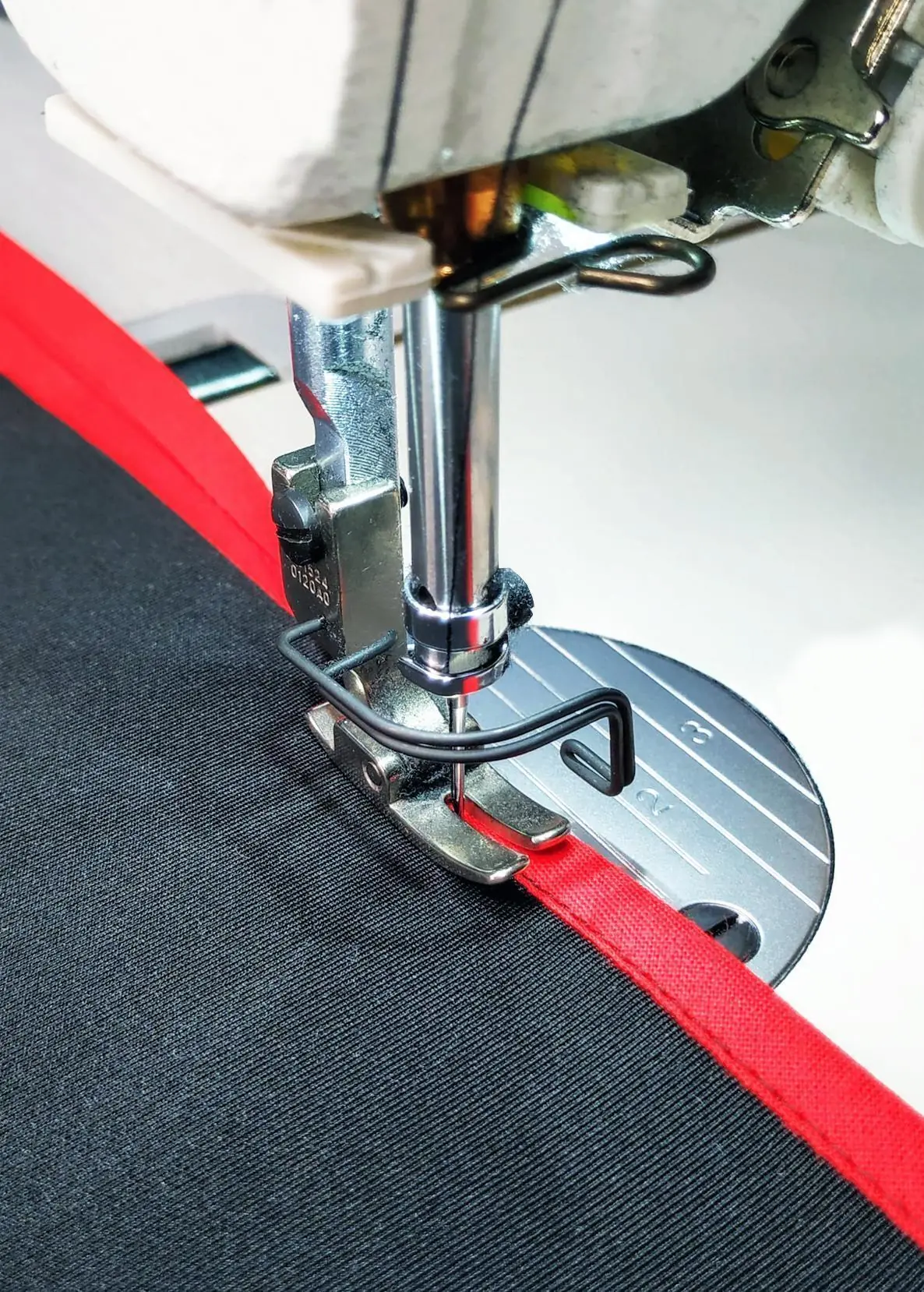
If polyester bias is stretched too much during application, it will tend to contract later, causing puckering in the finished garment. The operator needs to know the "personality" of the fibre to properly adjust the feed and presser foot.
Operational Comparison in Garment Plants and Finishing
The material choice not only affects the end user; it directly impacts production line efficiency. Each fibre requires different machine parameters and finishing conditions.
Ignoring these differences can lead to production bottlenecks or a high rejection rate in final quality control. Let’s analyse how these fibres perform under the stress of industrial processes.
To better visualise the critical operational differences between both materials, we have compiled the following key control points in the plant:
- Ironing temperature: Cotton withstands very high temperatures (up to 200°C), allowing vigorous pressing to set seams. Polyester is heat-sensitive (thermoplastic) and may shine or melt above 150°C without protection.
- Needle behaviour: Polyester is more abrasive and can heat the needle at high speeds, causing synthetic thread to melt. Cotton slightly lubricates the passage and keeps the needle cooler.
- Adhesive absorption: In fusing or interfacing processes, cotton's rough surface offers better mechanical anchorage for adhesives than polyester's smooth, crystalline surface.
- Lint generation: Cotton releases fibrils (lint) that can accumulate in the sewing machine hooks, requiring more frequent cleaning. Polyester is a much cleaner continuous filament.
Thermal Resistance: Behaviour in Ironing, Steam Tunnels, and Heat Setting
Thermal behaviour is perhaps the most drastic difference in the workshop. Cotton is thermally stable; it does not melt. It only degrades at extreme temperatures (carbonisation).
This allows the use of high-pressure steam finishing tunnels to remove wrinkles and sterilise the garment without risk to the binding. Cotton bias responds excellently to steam, swelling slightly and filling the seam.
Polyester is thermoplastic. It has a "glass transition point" at which it softens and can be moulded. This is advantageous for creating permanent pleats but risky for manual ironing.
Excess heat on polyester bias can cause an irreversible "glazing" or shine effect and even stiffen the tape, making it rough to the touch. Polyester finishing tunnels must be precisely calibrated to avoid thermal deformation.
Colour Fastness: Reactive Dyeing on Cotton vs. Disperse Dyeing on Polyester
Colour chemistry is another decisive factor, especially in combined garments (e.g. white body with red bias tape). Cotton is dyed with reactive dyes that form a covalent chemical bond with cellulose.
This offers good wash fastness, but cotton always tends to "age" visually, losing intensity progressively (wash-out effect), which sometimes is a desired aesthetic effect (denim, casual wear).
Polyester is dyed with disperse dyes at high temperature and pressure. The dye penetrates the polymer mass and becomes encapsulated.
The result is extraordinary colour fastness. Black polyester bias will maintain its intensity almost indefinitely, even resisting bleach (chlorine) and UV sunlight without fading. It's the go-to option for swimwear and sun-exposed clothing.
Dimensional Stability: Residual Shrinkage and Post-Wash Deformation
Here lies one of the manufacturer's biggest nightmares: differential shrinkage. If you sew cotton bias (which shrinks) onto a polyester fabric (which does not), after the first wash the seam will pucker.
Natural cotton has inevitable residual shrinkage (3-5%) unless it has been sanforised (mechanically pre-shrunk). At Byetsa, we treat our cotton bias tapes to minimise this effect, but the physics of the fibre always tends to contract with hot water.
Polyester is dimensionally stable. It does not shrink in normal domestic washes. If you use polyester bias on cotton garments that are going to shrink, the effect will be the opposite: the bias tape will "bag" or create waves.
The golden technical rule is to match the dimensional stability of the bias to the base fabric, or to subject materials to pre-wash tests to adjust patterns.
Technical Specification Criteria According to End Product Use
There is no universal "best bias tape." There is the right bias tape for each technical specification. The decision must be based on the product’s lifecycle, not just price per metre.
It is essential to analyse the end use, intended washing method, and safety regulations (e.g. flammability) to prescribe the correct component in the technical sheet.
Use Scenarios: When to Specify Natural Fibre and When Synthetic Fibre
To close this guide, we present a quick decision matrix. Specify cotton bias tape when the priority is dermatological comfort, sweat absorption, or a natural matt finish.
It is mandatory for baby clothing, high-end shirts, and garment dyeing processes where the bias must absorb colour at the same rate as the base fabric.
Specify polyester bias tape when the priority is mechanical resistance, colour fastness to the weather, or low maintenance (quick drying, no ironing). It is ideal for technical sportswear, swimwear, and high-visibility workwear.
And remember the polyester/cotton blend as the industrial all-rounder that balances strength and softness for large-scale uniform and fast fashion production. At Byetsa, we advise your technical team to find the exact formulation your collection needs.
We make what you need
Looking for bias binding for your production or your haberdashery?
Frequently asked questions
01Why does the bias binding seam pucker after the first wash?
It is usually due to differential shrinkage. If you sew cotton bias binding, which can shrink by 3-5% if not sanforised, onto a polyester fabric that does not shrink, the seam puckers. In the reverse case, polyester bias binding on a cotton garment that shrinks forms bags or ripples. It is advisable to match materials or carry out wash tests.
02Which bias binding best withstands bleach and sunlight?
Polyester. It is dyed with disperse dyes at high temperature and pressure, which become encapsulated in the polymer, giving it very high colour fastness against bleach and UV radiation. That is why it is the right option for swimwear and garments exposed to the sun. Cotton, on the other hand, tends to lose intensity gradually.
03At what temperature can you iron polyester bias binding?
Polyester is thermoplastic: above 150 °C without protection, it can turn shiny, melt or harden and become scratchy to the touch. Cotton, by contrast, withstands up to 200 °C and responds well to steam. In finishing tunnels, the parameters for polyester must be precisely calibrated to avoid thermal deformation of the single-fold binding.
04Which bias binding is recommended for uniforms and hospitality clothing?
The cotton and polyester blend. It combines the mechanical durability of polyester with the pleasant feel of cotton and allows garments to undergo aggressive industrial washing without losing the traditional look of cotton. Because of that balance, it is considered the industrial all-rounder for large uniform and fast-fashion production runs.
05How does the bias binding material affect work on the sewing machine?
Polyester is more abrasive, can heat the needle at high speeds and, if overstretched when applied, tends to contract and pucker the garment, so tension, feed and presser foot must be carefully adjusted. Cotton keeps the needle cooler, but sheds lint, which means the hooks need cleaning more often.
Related articles
Technical differences between bias tape, corded piping and flat piping
We analyse the technical differences between bias tape, corded piping and flat piping. Choose the perfect finish for your industrial sewing project with Byetsa.
Read article
The Importance of OEKO-TEX Certification in Children’s Textiles
Discover why OEKO-TEX Standard 100 Class I certification is vital in children's textiles. Ensure chemical safety and industrial competitiveness with Byetsa.
Read article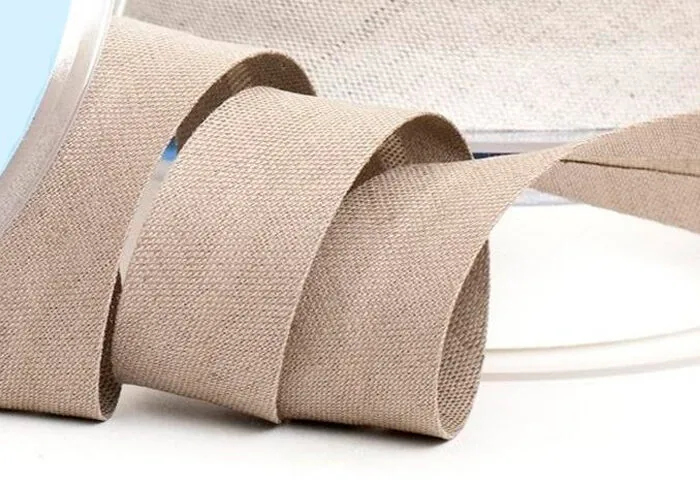
Luxury finishes: Using satin and lamé bias tape in haute couture
Lamé bias tape for haute couture. Discover its features and characteristics in this post. Request information with no obligation.
Read articleDo you have a question about bias binding?
If you have any questions about our products or need personalised advice, please do not hesitate to contact our team. We are here to help you in any way we can. Write to us!
- Phone93 874 40 98
- Emailinfo@byetsa.es
- AddressC/ Artés, 4 · Pol. Ind. Els Dolors · 08243 Manresa (Barcelona)
Tell us what you need
We will reply with the right reference, format and width for your production.