Faux leather bias tape: applications in leather goods and accessories
Discover Byetsa faux leather bias tape: technical composition, industrial and haberdashery formats, and applications in leather goods, footwear, and accessories.
 By Francesco ZagnoniPublished on 10 min read
Quick answer
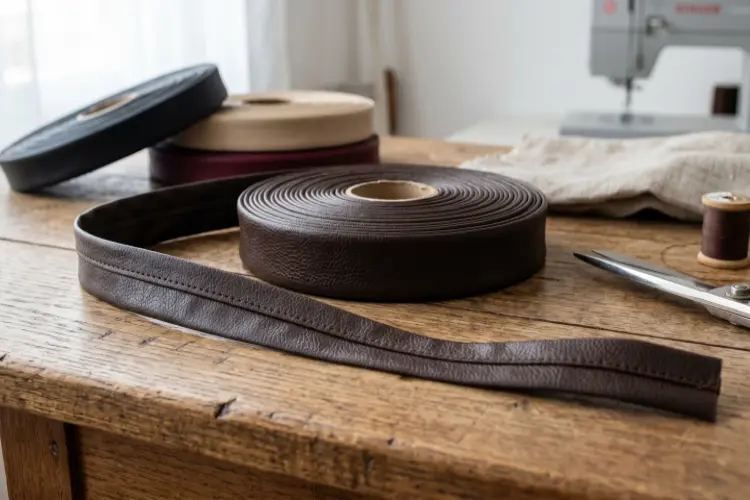
Faux leather bias binding is a bias-cut tape with a textile backing coated in polyurethane that imitates leather. Byetsa makes it in Manresa (31% polyester, 31% cotton and 38% polyurethane) for leather goods, footwear and accessories.
Key points
- Composition: 31% polyester, 31% cotton and 38% polyurethane; the textile backing provides structure and the polyurethane gives the leather look.
- It is used on handbags, backpacks, toiletry bags, casual footwear and accessories to finish edges and reinforce seams.
- To sew it, a microtex or leather 80/12 or 90/14 needle and a Teflon, roller or non-stick foot are recommended.
- Do not iron the faux leather side directly: use a pressing cloth and a moderate temperature.
- The shade may vary between batches: order each series in a single lot and keep a one-metre sample.
What is faux leather bias tape and why is it the industrial alternative to leather piping?
In leather goods, footwear, and accessories, finishes with a leather appearance remain a visual code associated with quality. However, working with natural leather in mass production poses structural problems: high prices, a shortage of homogeneous batches, material weight, regulatory restrictions, and a growing demand for animal-free products. For manufacturers who need to finish edges, outline seams, and provide a visual frame for the piece, these limits become a bottleneck.
Faux leather bias tape solves this bottleneck with a material that reproduces the feel and appearance of leather at a sustainable industrial cost and with a stable supply. It is a tape cut on the bias, manufactured with a textile backing coated in polyurethane, which behaves like conventional textile bias tape on the production line but with the visual finish of leather.
At Byetsa, we manufacture faux leather bias tape at our plant in Manresa for manufacturers of bags, backpacks, toiletry bags, casual footwear, and accessories throughout Europe. It is an industrial reference designed for productions where the finish defines the perceived value of the final product.
Technical composition of Byetsa faux leather bias tape: 31% polyester, 31% cotton, 38% polyurethane
Byetsa faux leather bias tape is manufactured with a composition of 31% polyester, 31% cotton, and 38% polyurethane. The textile backing (polyester + cotton) provides the structural base of the tape, while the polyurethane layer creates the surface with a leather look and feel. This proportion is not accidental: it balances the flexibility necessary for sewing and curving with enough rigidity for the piping to maintain its shape in the finished piece.
Compared to alternatives such as rigid PVC or thick-layered synthetic leathers, Byetsa's composition prevents cracking during flexion and maintains a warm touch closer to natural leather. Furthermore, the woven textile backing provides a solid base for stitching, without the risk of tearing around the needle line.
Physical properties: feel, flexibility, resistance, and solidity in production
From a technical point of view, faux leather bias tape behaves as a hybrid product: the faux leather side slides cleanly under the machine foot and withstands constant tension without stretching, while the textile reverse side accepts industrial threads without issue. It is flexible enough to outline soft curves (bag edges, shoe upper contours, pocket flaps) and just rigid enough so that the piping does not deform.
Abrasion resistance is one of its strengths, making it especially suitable for pieces subjected to continuous friction: bag handles, shoe upper piping, backpack edges, belts. Dimensional stability against ambient humidity is good and, with reasonable maintenance, the tape retains its appearance throughout the useful life of the piece.
It should be noted that faux leather shades may vary between production batches. This is not a defect: it is a characteristic of the coating process. The industrial recommendation is to order the bias tape required for a single series in one batch to guarantee chromatic uniformity.
Available formats: cut bias, single-fold bias, and piping in industrial and haberdashery presentation
Byetsa’s range of faux leather bias tape is offered in industrial productions upon request and in two models for haberdashery presentation. The catalogue indicates the models most frequently requested by manufacturers, but Byetsa can study the item required by the client and determine if it can be produced.
Applications of faux leather bias tape in leather goods, footwear, and accessories
Faux leather bias tape is a niche product, but its presence is absolutely structural in sectors that depend on the visual finish of the piece. Unlike classic textile bias tape, it does not only provide a technical function: it also provides a visual code. It defines the contour, marks the silhouette, and communicates quality without the need to add additional pieces.
Three major verticals consume faux leather bias tape on a recurring basis: leather goods, footwear, and accessories. In each, the tape fulfils a slightly different function, but the principle is the same: finishing the edge, reinforcing the seam, and elevating the perceived value of the final product.
Leather goods: bags, backpacks, toiletry bags, and shoulder bags
In leather goods, faux leather bias tape is used in four key positions: top edge piping, outlining exterior and interior pockets, reinforcing visible seams, and finishing handles. In a tote bag, for example, faux leather bias tape marks the upper contour and defines the visual frame of the piece; in a shoulder bag, it outlines the front pocket and reinforces the attachment of the handle to the body of the bag.
In urban and travel backpacks, faux leather bias tape delimits the exterior compartments and reinforces the areas of greatest friction: the bottom, lower corners, and the contour of the top handle. In toiletry bags and purses, it outlines the closure and provides the decorative finish for the edge. Its behaviour under industrial sewing allows for working at a constant speed without the technical stops required by natural leather.
For manufacturers who combine faux leather bias tape with fabrics such as denim, canvas, or technical nylon, the product's flexibility facilitates assembly and finish uniformity, avoiding the variations that a natural leather piping would introduce in each piece.
Footwear and technical accessories: edges, reinforcements, and decorative details
In casual footwear, faux leather bias tape appears in premium espadrilles, canvas trainers, casual-style loafers, sandals, and clogs. Its most common application is the outlining of the upper contour and the shoe collar, a position where the tape must withstand stitching traction and abrasion from use without losing its shape. Faux leather bias tape meets this dual requirement at a cost per pair much lower than that of natural leather.
Another frequent application is heel reinforcement and decorative side lines, where the bias tape functions as a design element and as structural protection. In seasonal sandals and espadrilles, it also allows for playing with colour combinations between the upper fabric and the piping without driving up production costs.
In technical accessories—belts, bag straps, sports luggage covers, textile accessories—faux leather bias tape replaces more rigid solutions such as leather strips or technical PVC tapes, offering a cleaner finish and significantly lower weight.
Cases, covers, and fashion accessories
The third major vertical is small accessories: glasses cases, mobile and tablet covers, notebook covers, travel accessories, and toiletry kits. In all these products, faux leather bias tape handles the edge finish with a professional result, preventing the base fabric from fraying and providing the visual frame that differentiates a basic accessory from a premium one.
In textile costume jewellery, fabric jewellery, and premium hair accessories (headbands, large-format bows, brooches), faux leather bias tape also functions as a decorative element. In these applications, smaller widths (10-18 mm) are usually used and combined with other families from the Byetsa catalogue to create texture contrasts.
For manufacturers working on short series or capsule collections, the availability of faux leather bias tape in haberdashery presentation (20-25 metre rolls) allows for producing small runs without committing to the MOQs of a full industrial order.
How to work with faux leather bias tape and professional purchasing criteria
Faux leather bias tape requires different handling than conventional textile bias tape. The presence of polyurethane on the visible side changes the rules for sewing, ironing, and maintenance, and ignoring these differences usually results in defective pieces, visible marks on the tape, or machine stops due to unsuitable needles.
Furthermore, faux leather shades may vary between batches due to the very nature of the coating process. This is a technical detail that should be known and planned for: for the same production, the bias tape must be ordered in a single batch. Those managing industrial purchases must incorporate this nuance into their ordering policy.
Sewing techniques, needles, and shade management between batches
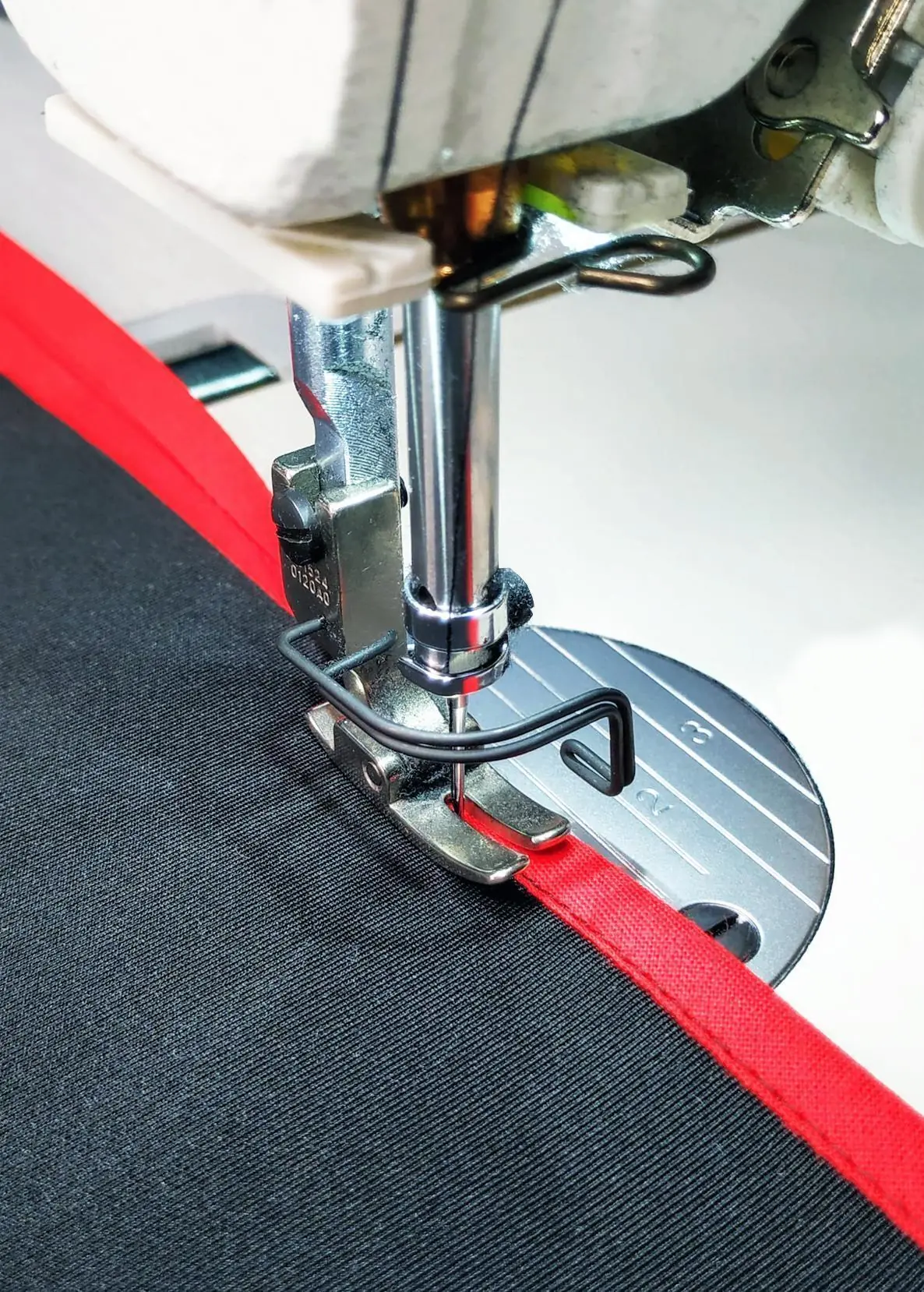
The first rule when sewing faux leather bias tape is to use microtex or leather type needles in 80/12 or 90/14 gauges. This type of needle penetrates the polyurethane layer cleanly without tearing it, avoiding micro-perforations that could become break lines with use. A sharp universal needle leaves visible marks on the faux leather side and reduces the tape's durability.
The second critical point is the presser foot: it is advisable to use Teflon feet, roller feet, or specific non-stick feet for synthetic leather. Conventional metal feet can slip or, worse, scratch the polyurethane surface. Recommended seams are straight stitching at low speed or decorative seams that take advantage of the piping’s visual contrast.
Regarding ironing, direct ironing should never be applied to the faux leather side. If ironing is needed to set folds, a protective cloth and moderate temperature must be used. Intense steaming can deform the polyurethane layer. For shade management between batches, the operational recommendation is to order all the bias tape needed for a collection or a series in a single batch and keep one metre as a reference sample to compare future replacements. If you have questions about the technical differences between flat bias tape and corded piping, consult our technical guide to choosing the right format.
We make what you need
Looking for bias binding for your production or your haberdashery?
Frequently asked questions
01How does faux leather bias tape differ from cotton or batiste bias tape?
The difference lies in the composition. Faux leather bias tape incorporates a polyurethane layer (38%) on a polyester and cotton textile backing, which gives it the appearance and feel of leather. A cotton or batiste bias tape is 100% textile and does not reproduce that aesthetic. Faux leather is used where the finish must look like leather; textile is used where breathability and a soft touch are paramount (childcare, lingerie, home).
02In what widths and formats is Byetsa faux leather bias tape available?
The range includes cut bias, single-fold bias, and piping. In industrial format, the width is according to the price list for specific productions. In haberdashery presentation, single-fold bias is offered in 18 mm and 30 mm in 20-metre rolls and piping in 10 mm in 25-metre rolls. For needs outside these standards, Byetsa can manufacture special widths upon request.
03What type of needle and seam should be used with faux leather bias tape?
The technical recommendation is a microtex or leather needle in 80/12 or 90/14 gauge, combined with a Teflon foot, roller foot, or non-stick foot for synthetic leather. The ideal seam is straight stitching at low speed, avoiding high speeds that can cause marks. Never apply direct ironing to the faux leather side: use a protective cloth and moderate temperature.
04Can faux leather bias tape be ordered in industrial format for large productions?
Yes. Byetsa manufactures the entire range of faux leather bias tape in industrial presentation with flat cut bias (ref. 0084110), single-fold bias (ref. 0284100), and piping (ref. 0684105). Industrial formats are designed for manufacturers of leather goods, footwear, and accessories who need constant volume. For large orders, there is also the possibility of special colours upon request.
05What range of colours does Byetsa offer in faux leather bias tape?
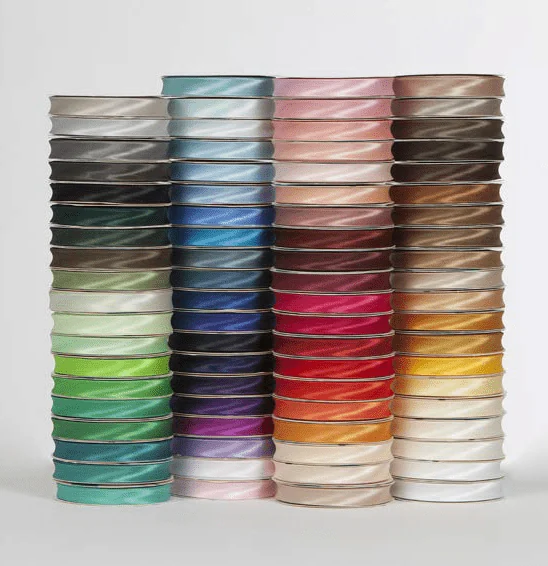
The standard colour chart for faux leather bias tape includes white, brown, leather, grey, black, and a mustard/cognac tone as the most requested references in leather goods and footwear. For industrial productions, Byetsa can manufacture special colours upon request based on minimum volumes defined by the price list, a frequent option for brands that need to match the piping to their chromatic identity.
06How should a piece finished with faux leather bias tape be washed and maintained?
The general rule is to wash in cold or lukewarm water (maximum 30°C), on a delicate programme, and without applying direct ironing to the faux leather side. The polyurethane layer does not withstand high-temperature washing or intense drying: both accelerate its degradation. The spin cycle should be gentle and, if the piece is ironed, it must always be done with a protective cloth and moderate temperature. For industrial productions intended for hospitality or professional laundering, it is advisable to validate the resistance of the faux leather to the client’s specific detergent and cycle with prior samples.
Related articles
Elastic Bias Tapes: Applications in Sportswear and Lingerie
Byetsa elastic bias tapes: 97% cotton and 3% elastane. Applications in sportswear, lingerie, knitwear, and activewear. Industrial and haberdashery formats.
Read article
Vichy Bias Tape Catalogue: the timeless classic for children’s fashion and home décor
Discover the Byetsa Vichy bias tape catalogue: three patterns, 15+ colours, industrial and haberdashery formats. Ideal for children’s fashion, home décor and childcare products.
Read article
Cost Optimisation in Garment Manufacturing: Advantages of Buying Bias Tape Wholesale in Europe
Optimise costs in your workshop by purchasing bias tape wholesale. OEKO-TEX quality, European manufacturing and fast delivery. Improve your profitability with Byetsa.
Read articleDo you have a question about bias binding?
If you have any questions about our products or need personalised advice, please do not hesitate to contact our team. We are here to help you in any way we can. Write to us!
- Phone93 874 40 98
- Emailinfo@byetsa.es
- AddressC/ Artés, 4 · Pol. Ind. Els Dolors · 08243 Manresa (Barcelona)
Tell us what you need
We will reply with the right reference, format and width for your production.